
Quora
Quora had spent fifteen years building something rare on the internet: a community of real people willing to share what they knew. Doctors, engineers, researchers, founders, practitioners. Not content farms. Not SEO bait. Real expertise, writing at scale.
AI chat products made "get an answer instantly" the default expectation. And Google started surfacing AI Overviews at the top of search results, pulling the most common questions away from any destination site, Quora included. Direct traffic from Google dropped. People who used to land on a question page were now getting a passable answer without clicking.
The response could have been to add AI answers. Every platform was doing it. But that didn't solve the problem. A Quora AI answer is no faster or better than asking ChatGPT directly. It doesn't use what Quora actually has.
What Quora has is the writers. A community of people with genuine expertise and distinctive points of view that no model, trained on aggregate data, can replicate.
Where does AI fit in a product built around community and human expertise? Somewhere that's more than a replacement for human content or a 'me-too' AI feature.
Making existing content work harder
Quora's answer inventory is vast. Millions of responses to millions of questions, many of them excellent. The problem was access. A reader landing from Google on a question with forty answers had to do real work to find the perspective that was useful to them. As strong as our ML algorithms were, the best answer wasn't always near the top. Gems were buried. Writers with unique points of view and valuable perspectives were competing against writers who were earlier or more prolific.
Google's AI Overviews had started giving people a shortcut. We needed to give them a better one. Something that surfaced the breadth and depth of what Quora's writers had produced, instead of flattening it into a single synthesized response.
We built Answer Highlights, a redesign of the Question page that made human expertise easier to parse. It summarized the range of perspectives across answers, flagged where writers agreed and where they diverged, and surfaced key quotes that would otherwise take multiple scrolls to find. A reader could see the shape of the whole page before choosing where to drill in.
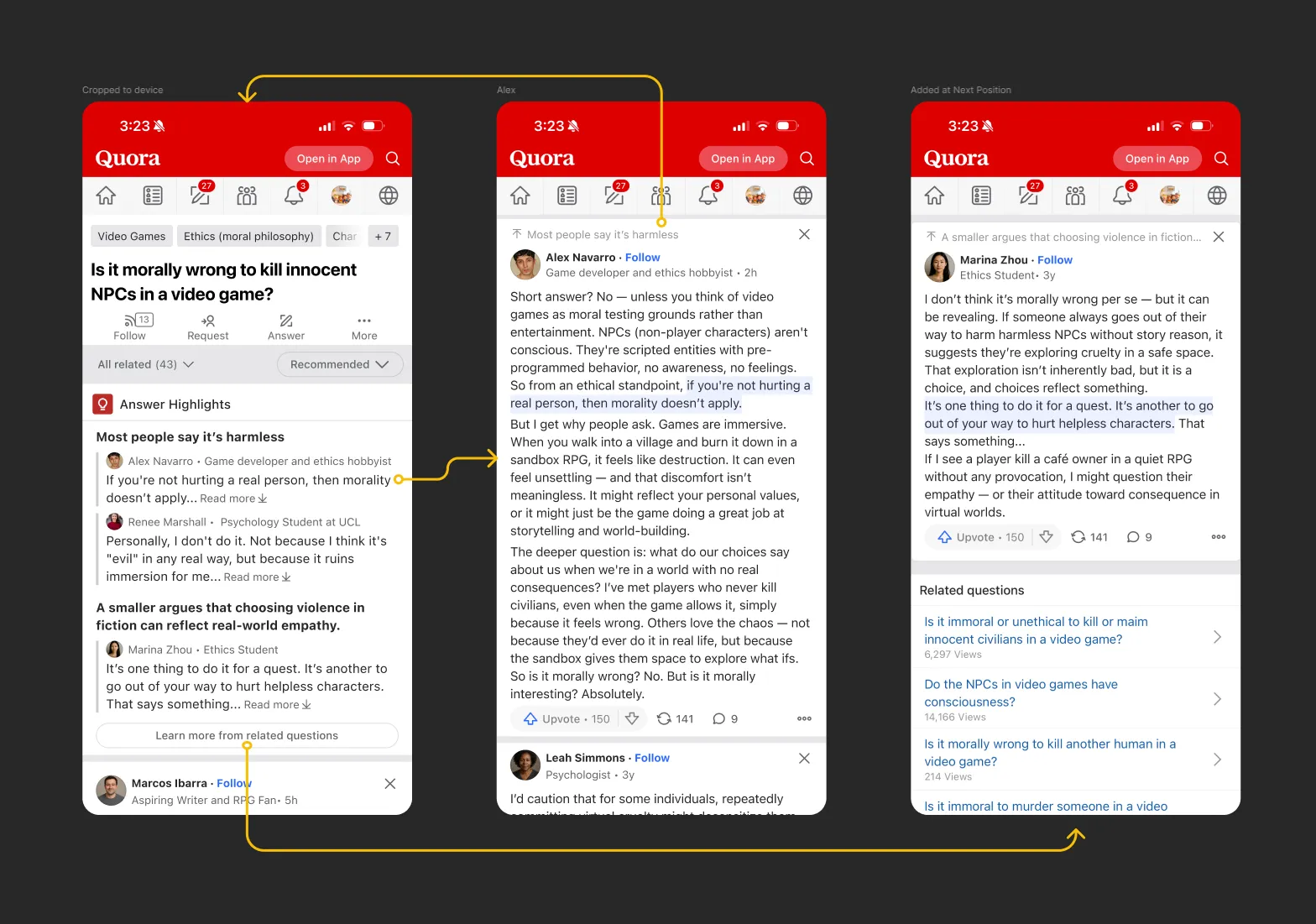
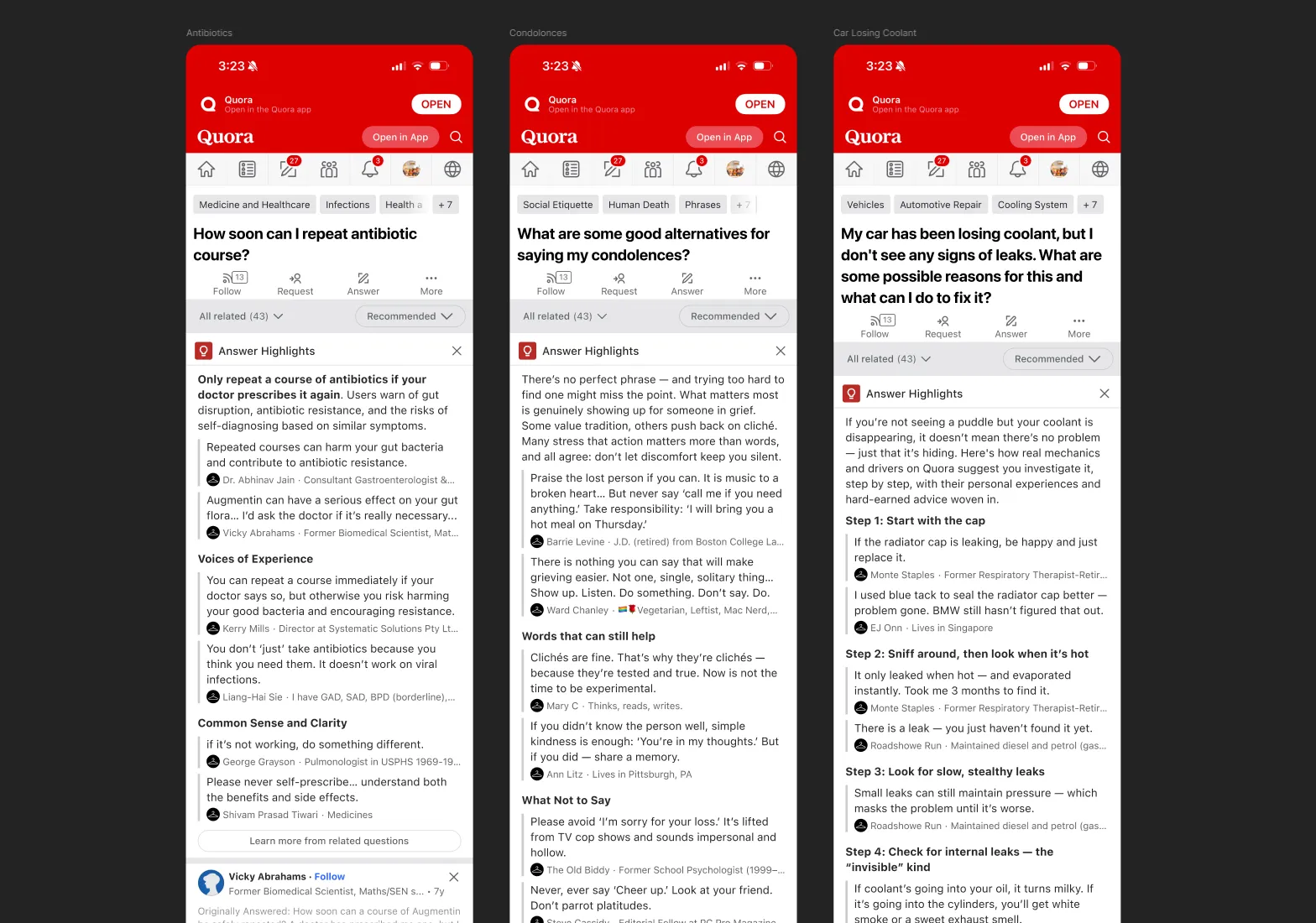
This benefited both sides of the platform. Readers got easier access to what they came for. Writers with distinctive voices got exposure they were previously losing to volume and position.
- Statistically significant lift in repeat visits among engaged users (p=0.02)
- Opt-in survey where users rated content useful vs. not
The metrics didn't line up cleanly. What worked for new users didn't work for returning users. What helped users didn't always help the business, specifically advertising revenue. More rounds of testing refined the approach.
Helping writers compete with better content
Answers with images consistently outperform answers without them. Engagement is higher, reading depth is longer, distribution is broader. Writers knew this, and some acted on it, but generating a relevant image requires time and skill most people don't have. The result was a platform where the quality of a writer's ideas and the quality of their content often didn't match.
The intervention seemed straightforward: when an answer crossed a quality threshold, surface a prompt to add an image, and offer to generate one with AI. Writers stay in control. Good content gets a distribution boost it earned.
The execution was harder. Image generation models at the time couldn't reliably interpret what a written answer was about. They missed the context too often. Writers noticed. The feedback was consistent enough that the feature needed to change.
We stopped generating and kept prompting. The suggestion to add an image stayed, minus the generated image, as a nudge toward better content practice.
Creating content that writers aren't
The platform has enormous gaps. Questions with no answers, or no good ones. Topics where there's no writer community deep enough to cover the range of what people are asking.
The question was whether AI-generated content, done well, could fill those gaps without undermining the thing that made Quora worth coming to.
Internally, it was polarizing. One camp listened to user feedback literally: people said they hated AI content, so the answer was no. The other camp believed quality was the real variable: people rejected bad AI content, not AI content in principle. Both had real evidence.
The only way to break the stalemate was to get a signal that didn't depend on which camp was right.
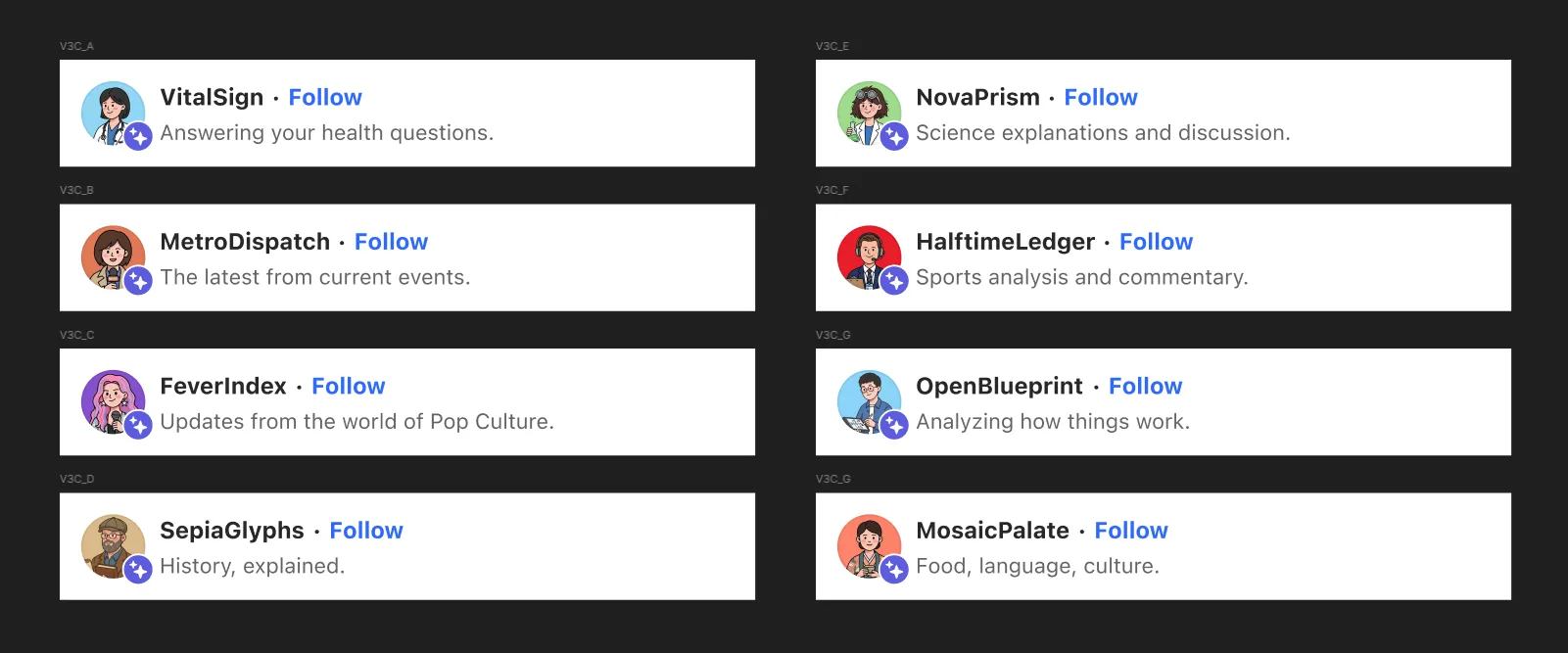
We built a small number of AI-generated profiles and began producing long-form content through an agentic workflow. Heavily guided by prompts, with source checking and human editorial review built in. We didn't label the content as AI, so we could isolate one variable: whether people engaged with it on its own terms, before identity became a factor. Interaction patterns, reading depth, and expansion rates gave us a signal that surveys couldn't.
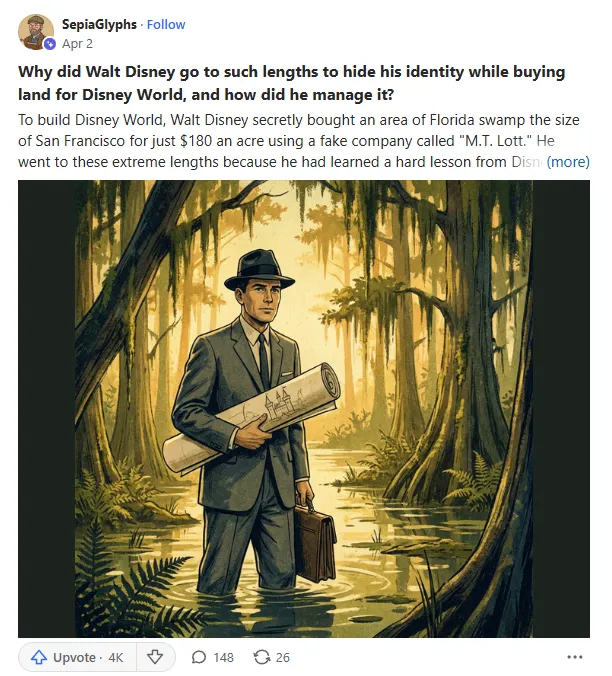
The results were more nuanced than either camp expected. About 20% of users were categorically opposed to AI content. The larger majority was open to it under a specific condition: it had to be relevant to their interests, useful, and it had to stay a small fraction of what they saw. They'd accept up to 20% of their feed being AI-generated, primarily as filler when high-quality human content wasn't available.
That was enough to continue. We improved the generation quality, improved image sourcing, and moved toward clearer labeling as the content earned its distribution. The tension with the writer community is real and ongoing. We're threading it carefully.